When Milwaukee braced for tornados tonight, the first damage we saw was to journalism
By Rob Golub
Earlier tonight, my wife called from choir practice to tell me to bring the dogs down to the basement.
I’m already on it, I said, though this was marketing puffery at best. One dog would run from me just as I captured another, as the tornado siren wailed in the background. The notification on my phone must have been fun to design - an exclamation point in a red triangle, next to the word “CRITICAL,” also in red.
“Imminent Threat Alert … National Weather Service … Tornado Warning in this area until 7:30 PM CDT.”
I imagined a tornado hitting just as I finally dragged the dogs, one in my arm, the other one by her collar, a golden retriever sadly terrified of the plastic bags at the base of the stairs.
I promise, I was nice. But there was that siren. And the red triangle. But I was nice.
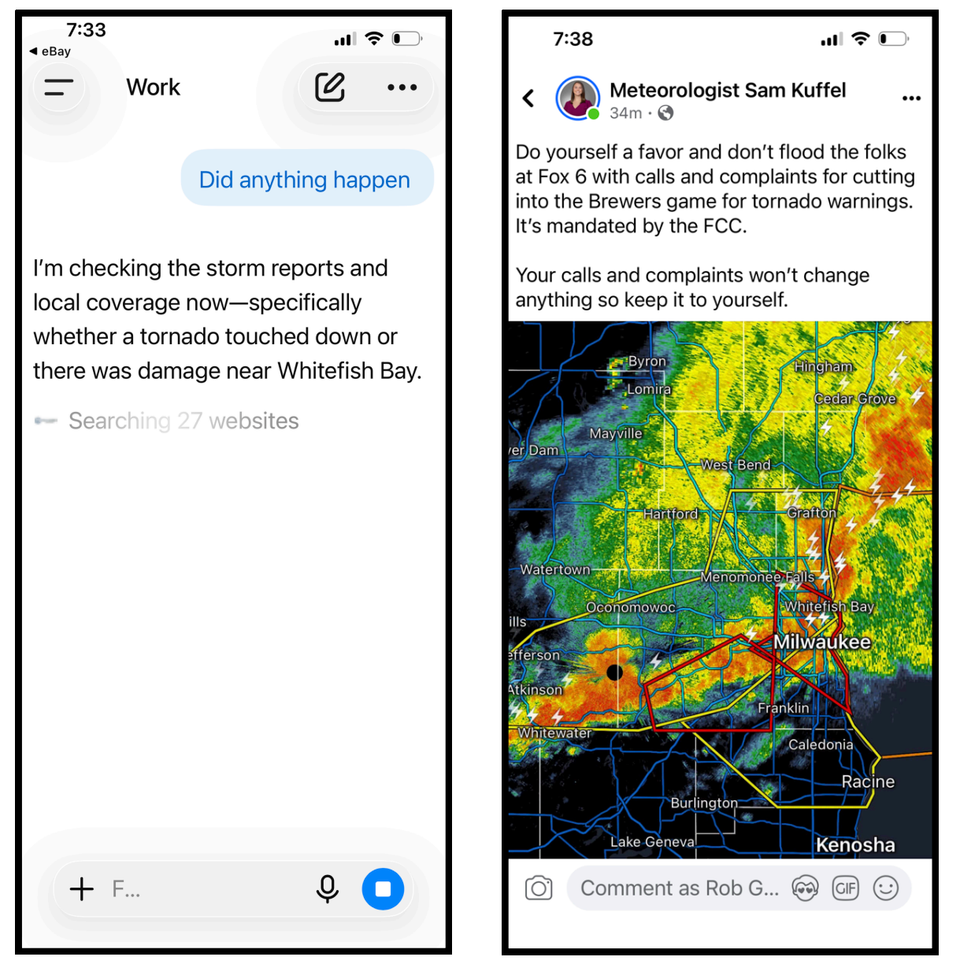
When 7:30 p.m. came around I did not flick on the news or the radio for the latest. I asked Chat GPT. In the new Chat GPT work mode, which for me at least has only been enabled in recent weeks, it searched dozens of sites when I asked if it was fine to come upstairs, and then dozens again when I asked if anything happened out there.
I got my answers.
I was served no ads from news organizations. This, my friends, is a revenue black hole. It’s even an engagement black hole. I visited no sites. I just used AI.
If journalism is going to survive this approaching sea change, merely providing the information won’t be enough. We have to give people a reason to seek us out instead of accepting an answer from an intermediary. That reason is relationship.
I know nobody wants to hear this, but I’m a 59-year-old journalist and I’ve seen this movie before. Everyone wants to pretend tech is not changing journalism, but that does not work. We need to stop preparing for the world that existed two years ago.
Here’s what works. When we show some of who we are, when we behave like humans, our audiences value us. We call this “emotional engagement of a journalism audience.” It’s thinking about your relationship with your audience, even as you do your journalism.
I’ve never met Meteorologist Sam Kuffel, but I love to watch her go because even though I think I know what I’m doing, I also think she’s the real pro. I can learn from her.
The former Milwaukee TV weather journalist, now with 40,000 Facebook followers, posted: “Do yourself a favor and don’t flood the folks at Fox 6 with calls and complaints for cutting into the Brewers game for tornado warnings. It’s mandated by the FCC. Your calls and complaints won’t change anything, so keep it to yourself.”
Let’s run through some of our guidelines and motivators, for a snapshot of why we love this.
We serve our community. That includes protecting Fox 6 from a tornadic deluge of phone calls - they are part of our community.
Emotional connection / Know your audience: She knows from her own life experience that people are watching the Milwaukee Brewers and that they will call. She’s one of us.
Content they can’t get anywhere else: Who else is going to say this stuff?
Empower your audience: We are empowered to not make a needless phone call.
She gives her audience something to talk about, makes them feel smarter, acts as a user guide to the community, and makes them smile - it’s all there. The smile is tied to the attitude, which when pulled off well, is gold.
She’s probably never even seen my motivators, just follows them instinctively.
Kuffel also constantly posts serious weather news – reports, information about warnings, maps and so forth. This is not about fluff versus real news. This is not about big media versus small. It’s about the power of emotionally engaged media to draw people into our news products and earn their trust.
Because of how she talks to me, I trust her.
Nobody knows for sure exactly where journalism is headed, but it might be safest standing next to the Kuffels of the world.
___
Like what you read?
We're building a movement for greater trust in journalism, rooted in emotional engagement of audiences. If this resonates with you, please forward this to a colleague or friend who cares about the future of local or community news.
For additional practical steps, check out the Successful Journalism One-Sheet Guide. New journalists, please see the Lab and Journalism Basics pages.
Together, we can create journalism that communities believe in.