If police can practice servant leadership, how about journalists? Here’s the Marquette University police model
By Alexandra Fahey, Lab Reporter
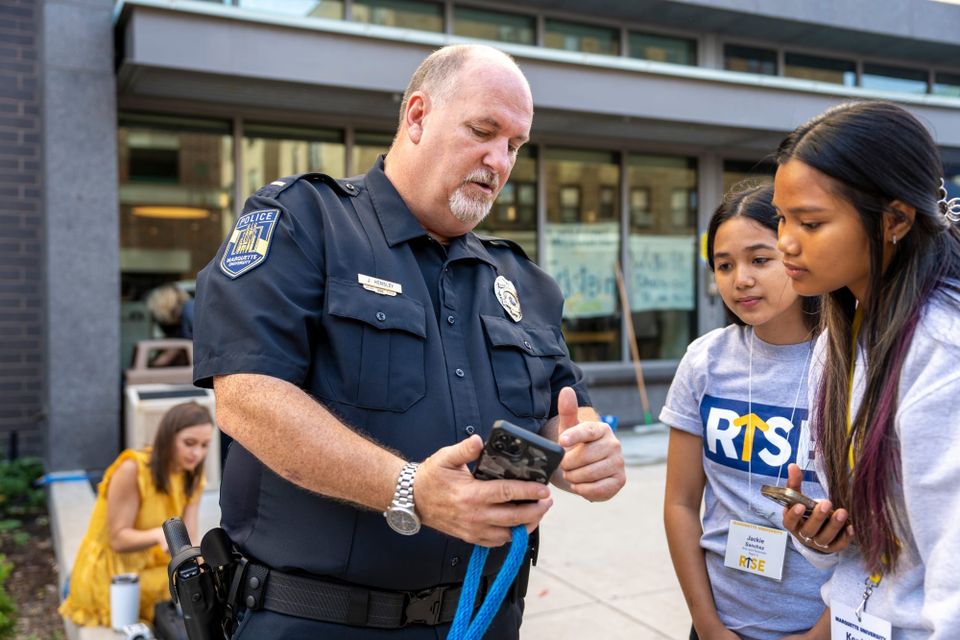
Police Lieutenant James Hensley recalled the scene at a Milwaukee street corner: a man shouting near traffic. To many passersby, he must have seemed a disturbance.
When Marquette University police responded, they saw someone afraid to cross the street.
An offered arm is enough. As Hensley remembers it, they walked that man across, the shouting stopping. Again. This, Hensley of the Marquette University Police Department explained, is just how simple and effective servant leadership in law enforcement can be.
At a time when this site and others are advocating that local journalists must think and act as community servants, this police department may offer a glimpse of what is possible when neighborhood institutions become neighbors.
Under the leadership of Chief Edith Hudson, the department, which serves both the private Jesuit university and the surrounding Milwaukee community, has woven empathy and stewardship into its relationships with officers, students and locals alike—principles of a guiding framework called servant leadership.
The philosophy asks officers to approach their communities as stewards with a responsibility to help rather than as distant authority figures. Since joining the Marquette police in 2018 after serving as assistant chief of the Milwaukee Police Department, Hudson has invested heavily in making this framework part of the department’s culture.
“We understand that we're all part of a community,” Hudson said. “And that, as being part of a community, we need to come together for a joint solution that is not just something that law enforcement has created, it’s something that we develop and create as a team.”
Hudson’s commitment to this leadership model begins with her own officer, she said. When Hensley retired from his detective work with the city and joined Marquette, Hudson invited him to attend an international servant leadership symposium, where he received his first formal introduction to the mindset of his new department. What began as a professional development opportunity became something else entirely.
“On the edge of my seat, I was taking notes,” Hensley said. “I was genuinely excited.”
Yet the experience also left him uneasy: Why had no one introduced him to these ideas sooner?
“I was a little disappointed. I’m literally closing the door on one career, and I’ve never heard of this before, and yet it dovetails so perfectly with what we do,” Hensley said.
“Protect and serve” has long been the motto associated with local policing. Hensley believes the first half of that promise is often the one the public recognizes most.
“The protect is the easy stuff. We're going to protect you from someone who's going to do harm….That’s easy to see,” Hensley said. “The serve part is everything else, and that's really unlimited, but that's what we do the majority of our time…we serve in all sorts of different ways.”
Marquette University is an urban campus community of nearly 12,000 students, situated between downtown Milwaukee's business district and some of the city's most economically distressed neighborhoods. Sometimes its police department's service begins with offering an arm to a man afraid to cross the street. Other times, it takes the form of a phone call to the victim of a crime, not to gather evidence, but to ask what they need. If someone is afraid to appear in court alone, an officer may drive them there.
To Hensley, these everyday moments exemplify what it means for the department to “go that extra mile.”
Hudson believes that this service is instinctive, deriving from the intuitive alignment between servant leadership and policing.
“I just try to treat people like I would want to be treated, like I would want my children to be treated, or any other person that I love,” Hudson said. “And with my belief system, it's just the right thing to do.”
This focus on the “right thing to do” also shapes how the department determines its impact.
When the department launched a questionnaire asking people experiencing homelessness why they spent time near campus, officers expected to hear about food, clothing and other basic needs. In addition to these essential resources, Hensley recalls respondents citing feelings of safety with Marquette officers.
To Hensley, this response offers one example of success. To Hudson, it points to an even larger one. The Marquette police department’s goal, she said, is not only to respond to calls, but to help people address the root causes of their problems so they “don’t have to come back” and “don’t have to be involved with the criminal justice system.”
Hensley, who received his master’s degree in organizational leadership with a concentration in servant leadership from Gonzaga University this past spring, believes the lessons of servant leadership extend far beyond policing.
When asked about applying servant leadership to other disciplines, including journalism, he said servant leadership begins by asking the same question:
“How can I be helpful?”

Like what you read?
We're building a movement for greater trust in journalism, rooted in emotional engagement of audiences. If this resonates with you, please forward this to a colleague or friend who cares about the future of local or community news.
For additional practical steps, check out the Successful Journalism One-Sheet Guide. New journalists, please see the Lab and Journalism Basics pages.
Together, we can create journalism that communities believe in.