What a better newspaper front page looks like
By Rob Golub
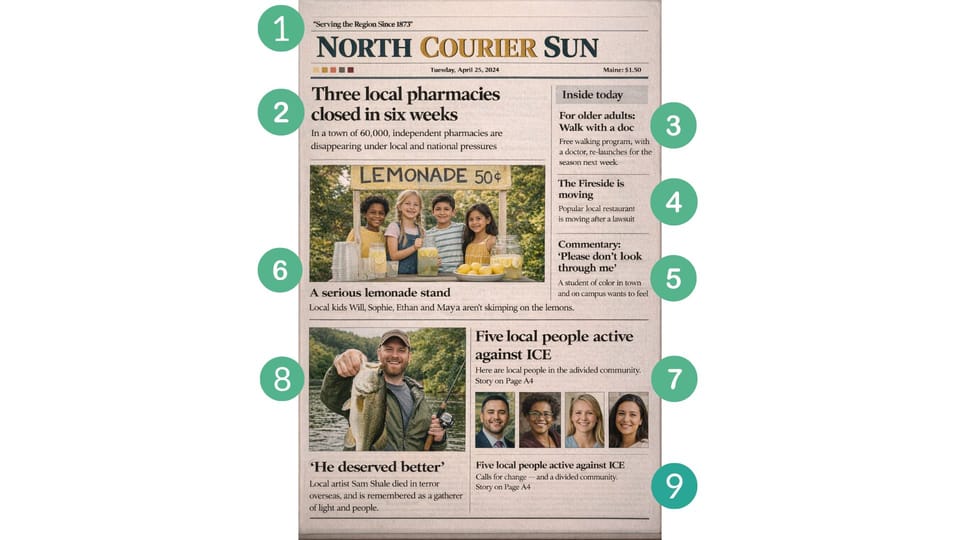
Last month, we critiqued the front page of the fictional North Courier Sun. This month, we rebuilt it.
The staff asked two fair questions. How can we be more emotionally engaging? And how can we earn trust at a time of misinformation, when people so are hungry for truth and genuine service?
Our answer is Successful Journalism, grounded in research, experience, and real-world constraints. This front page is one example of what that looks like.
Welcome to a new and improved edition of the North Courier Sun. There is a lot to like here, and some things to wrestle with. That is the point.
Here are nine things to know about this better front page.
1. “Serving the Region Since 1873”
This is a strong tagline. It emphasizes service and longevity at a time when authenticity matters. If you choose to focus on print, consider leaning in. For example: “Your Courier Sun. Never for the clicks. Just for you. Since 1873.”
2. “Three local pharmacies closed in six weeks”
This headline touches many lives. Independent pharmacies are disappearing under local and national pressures, and readers feel it directly.
This is enterprise journalism that matters. It informs readers, gives them something to talk about, and positions the newsroom as a useful guide to the community.
3. “For older adults: Walk with a doc”
This triggers the go-and-do motivator and serves the community in a practical way. Often, this is an easy press release rewrite or a quick reported item. It belongs on the front page. It serves.
4. “The Fireside is moving”
This is earned local drama. People know this restaurant. They know the staff. They may know the owner.
Stories like this give readers something to talk about and bind readers to your news service. This is content people cannot get elsewhere.
5. Commentary: “Please don’t look through me”
This triggers the ordinary people motivator. This is someone we know, or could know. We also help the reader feel smarter.
This is not window dressing. It is a look at the complexity of modern life. Serving the public means doing meaningful work.
6. The lemonade stand photo
This page includes real reporting expectations, but it also respects limited resources.
This photo does emotional work with almost no reporting burden. You stopped, took the photo, and wrote a strong caption. I’d prefer a more newsy shot where the kids are not posing, where they are running a serious lemonade stand, surrounded by too many lemons. Give us names and faces, and make us smile.
7. “Five local people active against ICE”
Audiences connect with names and faces, not abstractions. Humans also like numbers and limits. Here are five.
Brief profiles of ordinary people encourage sharing and conversation. This is not about ideology. It is about human-scale journalism.
8. “He deserved better”
Yes, he did. And the community newspaper is the right place to say so, with care and restraint. Local news organizations must allow themselves to be community cheerleaders when the facts earn it.
9. The bottom right space
We’ve got no City Hall news on this page. Maybe that could go here. City agendas can produce relevant, emotionally engaging items if viewed through daily life. What is changing on your streets this week? What decision affects tomorrow? Or, emotional engagement aside, what must we do to fulfill our public watchdog role?
The takeaway
A strong front page does not shout. It recognizes people, reflects daily life, and earns emotion instead of manufacturing it
You do not need unlimited resources. You need intention, prioritization, and the courage to serve in a world that too often emphasizes taking over giving.
Like what you read?
I’m building a movement for greater trust in journalism, rooted in emotional engagement of audiences. If this resonates with you, please forward this to a colleague or friend who cares about the future of local or community news.
For additional practical steps, check out the Successful Journalism One-Sheet Guide.
Together, we can create journalism that communities believe in.